
Tankless Water Heater Installation & Repair in Anchorage, AK
As Southcentral Alaska's trusted heating contractor and licensed plumber in Anchorage, AK, 907 Heating and Plumbing provides 24/7 tankless water heater repair, cold-climate precision sizing, descaling maintenance, and full installation across Anchorage, Eagle River, and the Mat-Su Valley. Engineered specifically for Anchorage's near-freezing 35°F municipal groundwater, our condensing systems deliver continuous on-demand hot water with no extra charge for nights or weekends. Call (877) 570-8952 for a free estimate.
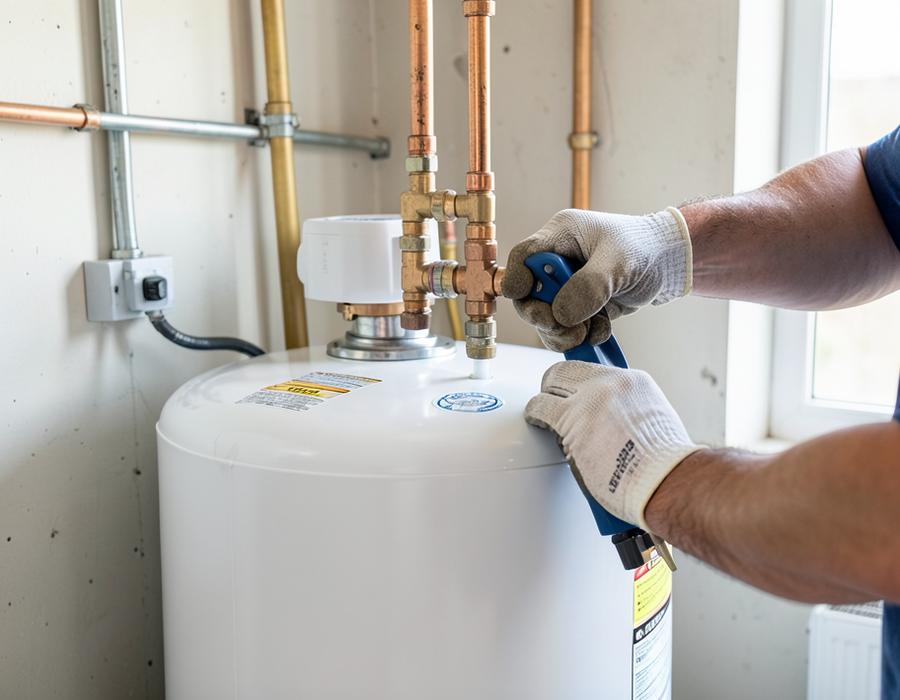
Active Tankless Error Code or No Hot Water?
When a tankless digital controller flashes a fault code (such as Rinnai code 11/12, Navien E003/E012, or Noritz 11), prompt diagnostic assessment pinpoints the component failure:
Ignition / Flame Failure
Inadequate gas pressure, frozen condensate drain lines, or oxidized flame rod sensors.
Thermal Overheating
Severe mineral scale restriction in the heat exchanger causing high thermal limit trip.
Exhaust Vent Restriction
Sub-zero exterior hoarfrost buildup or wind-driven snow blocking concentric vent terminations.
Why Tankless Water Heaters Require Special Sizing in Anchorage
Most online tankless sizing charts are calibrated for southern climates where incoming groundwater averages 55°F to 65°F. In Anchorage, incoming municipal water from Eklutna Lake and mountain wells drops to 34°F to 38°F from November through April.
Sub-Arctic Water Rise Requirement
To heat 35°F incoming water to a safe, comfortable shower temperature of 120°F, the burner must produce an 85°F temperature rise (Delta-T). At this extreme temperature differential, a standard 140,000 BTU unit that produces 7.5 GPM down south drops to just 2.8 GPM in Anchorage—barely enough for one shower and a kitchen faucet.
High-Capacity Multi-Bath Sizing
We install high-efficiency condensing tankless systems (Navien NPE-A2, Rinnai SENSEI) firing up to 199,000 BTU/hr with thermal efficiencies exceeding 96% AFUE. This ensures your home maintains 4.8 to 5.4 GPM of continuous hot water even on -20°F Anchorage winter mornings.
Storage Tank vs. Condensing Tankless: Alaska Comparison
Evaluating whether to stay with a conventional storage tank or upgrade to on-demand tankless:
| Feature / Specification | Standard Storage Tank | Condensing Tankless System |
|---|---|---|
| Hot Water Capacity | Limited to 40–50 gallons (Runs out) | Endless continuous flow |
| Average Lifespan | 8–12 years in Anchorage | 20+ years (Replaceable parts) |
| Thermal Efficiency | 60%–68% UEF (Standby heat loss) | Up to 96%–98% UEF (Ultra-efficient) |
| Physical Footprint | Consumes 12–16 sq ft floor space | Wall-mounted compact suitcase size |
| Gas Line Requirement | Standard 1/2-inch line (36k BTU) | Dedicated 3/4-inch to 1-inch (199k BTU) |
| Flooding Risk | High (Catastrophic tank rupture) | Minimal (No standing stored water) |
Anchorage Code Compliance & Installation Standards
Installing a tankless water heater in Anchorage requires compliance with the Municipality of Anchorage (MOA) Title 23 Mechanical and Plumbing Codes:
Gas Line Capacity Sizing
A 199,000 BTU unit requires substantial gas volume. We verify that your Enstar meter and interior manifold deliver adequate pressure without starving your heating boiler. Learn more on our gas line installation page.
Seismic & Structural Mounting
Because Anchorage is in Seismic Zone D2, wall-hung units must be anchored with heavy timber backing plates bolted into multiple 2x4 or 2x6 wall studs, preventing detachment during regional seismic activity.
Direct Vent Freeze Prevention
Condensing units use Category IV PVC/polypropylene direct venting. We engineer vent terminations with proper snow clearance above ground level and wind-resistant hoods to prevent exterior blizzard blockages.
Annual Descaling Service Valves
Every installation includes dedicated isolation and flush valves (Webstone purge valves), enabling seamless annual vinegar descaling without taking the system apart.
Verified Anchorage Tankless Customer Reviews
“Replaced an old 50-gallon tank with a Navien tankless system. With four kids, someone always took a cold shower in winter. Now we never run out of hot water, and our utility closet has so much extra storage space. 907 did a clean, code-compliant install.”
“Our tankless heater threw an ignition error code on a freezing Friday night. The 907 technician came out within an hour, diagnosed an iced-up condensate drain, thawed it, and descaled the unit. Honest, knowledgeable, and no after-hours gouging.”
Frequently Asked Questions About Tankless Water Heaters
- Do tankless water heaters work effectively in Anchorage sub-zero winters?
- Yes, provided they are engineered for sub-Arctic groundwater temperatures. In mid-winter, municipal water from Eklutna Lake enters Anchorage homes at 34°F to 38°F. Raising that water to 120°F requires an 82°F to 86°F temperature rise (delta-T). When sized with a high-BTU condensing model (180,000 to 199,000 BTU) and adequate gas supply, a tankless system delivers endless hot water through the coldest Alaska cold snaps.
- Will I need to upgrade my gas line for a tankless water heater?
- Often yes. Standard 40-to-50-gallon atmospheric storage tanks burn 36,000 to 40,000 BTU/hr, whereas whole-home tankless units demand up to 199,000 BTU/hr on instant demand. Our technicians calculate your existing gas manifold load and frequently install dedicated 3/4-inch or 1-inch gas lines to guarantee safe operation without starving your heating boiler or furnace.
- How often do tankless water heaters need to be descaled in Anchorage?
- We recommend an annual descaling flush (every 12 months) in Anchorage. Glacial runoff and municipal water carry mineral compounds that precipitate onto high-efficiency copper and stainless-steel heat exchangers, creating thermal barriers that reduce efficiency and trigger overheat safety lockouts.
- What is the 'cold water sandwich' and how is it prevented?
- The cold water sandwich occurs when a hot tap is turned off and immediately back on. A small slug of unheated water passes through the unit before the burner reignites. Premium condensing units with built-in mini buffer tanks or internal recirculation pumps eliminate this issue completely by maintaining immediate hot water delivery.
- What happens to a tankless water heater during an Anchorage power outage?
- Because tankless units rely on electronic control boards, electric ignition, and draft inducer fans, they will not operate during a utility power failure unless connected to a dedicated battery backup (UPS) or standby generator. We can install compatible electrical connections and automatic freeze-drain valves to protect the unit during winter blackouts.
- Do you charge extra for emergency tankless repairs on nights or weekends?
- No. 907 Heating and Plumbing provides 24/7 emergency diagnostic and repair services with zero overtime charges for nights, weekends, or holidays across Anchorage and our 50-mile service radius.
$25 OFF
Your First Service
Use Code: 907SAVE
Don't wait until a small plumbing or heating problem becomes a big repair. Book your service today.
Book Your Service Now