
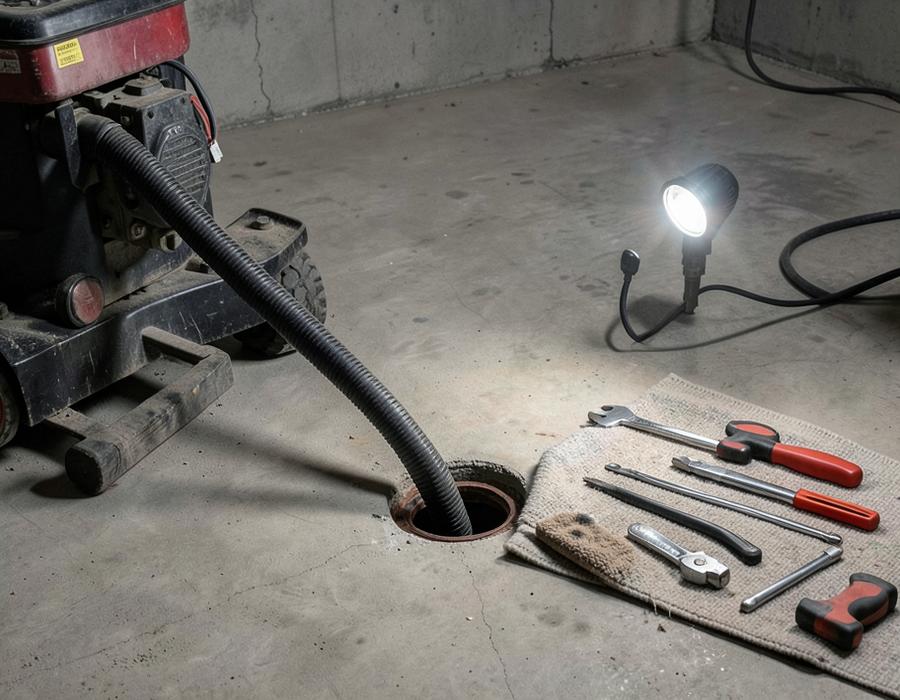
Understanding the Pipe Ovality Calculator
The Pipe Ovality Calculator determines the degree of out-of-round deformation in buried or pressurized pipes. Maintaining structural roundness is critical to preserving cross-sectional hydraulic flow, preventing gasket joint seal failures, and avoiding structural buckling under heavy soil overburden and freeze-thaw cycles.
What Is Pipe Ovality and Why Does It Matter?
Pipe ovality, also referred to as out-of-roundness, is the degree of deviation of a pipe's cross section from a true geometric circle. In underground civil drainage, gas piping, and water mains, ovality occurs due to improper transport strapping, thermal distortion, or excessive soil overburden after trench backfilling.
When flexible pipes like PVC or HDPE deform under earth loads, horizontal soil resistance prevents further vertical collapse. However, if ovality exceeds 5%, the hydraulic capacity drops, joint gaskets lose watertight compression causing groundwater infiltration, and sewer clearing equipment can become jammed.
Alaska Pro-Tip: In Anchorage, frost heave in poorly compacted sub-base gravel exerts uneven localized side pressures during winter. Always specify SDR 35 or heavy-wall SDR 26 PVC for deep municipal lateral connections.
How to Calculate Pipe Ovality Formula
Pipe out-of-roundness percentage is mathematically defined by the standardized equation: Ovality % = [2 × (Dmax - Dmin) / (Dmax + Dmin)] × 100, where Dmax is the maximum outside diameter and Dmin is the perpendicular minimum diameter measured across the same cross section.
For buried flexible pipes, diametral deflection % is measured relative to nominal base diameter: Deflection % = [(Nominal OD - Dmin) / Nominal OD] × 100.
Types of Pipe Ovality & Deflection Calculators
Depending on the engineering trade, professionals use different variations of ovality calculations: 1) Diametral Deflection Calculators for municipal sewer mandrels (ASTM D3034), 2) Out-of-Roundness Calculators for high-pressure API 5L steel gas and oil conduits, and 3) Butt-Fusion Alignment Calculators for HDPE civil water lines.
Common Applications in Plumbing & Civil Systems
In residential and commercial plumbing, ovality measurements are vital when installing deep sewer laterals under driveways, trenchless pipe bursting runs, hydronic district heating supply lines, and industrial flanged connections where deformed pipe ends prevent leak-free mechanical gasket seals.
Industry Standards and Tolerance Levels
Different pipe applications enforce distinct ovality tolerance thresholds:
| Standard Specification | Pipe Material | Maximum Ovality Tolerance | Verification Method |
|---|---|---|---|
| ASTM D3034 / F679 | Gravity Sewer PVC | 5.0% Maximum Deflection | 9-Arm Proving Mandrel Pull |
| ASTM F714 | HDPE Water & Gas | 3.0% Maximum Ovality | Laser Profilometry / Pi Tape |
| API Spec 5L | Carbon Steel Line Pipe | 1.5% Out-of-Roundness | Mechanical Micrometer Gauge |
| AWWA C151 | Ductile Iron Pipe | 2.0% Maximum Ovality | External Caliper Survey |
Step-by-Step Pipe Measurement Process
1. Clean the pipe surface thoroughly of mud, ice, and burrs. 2. Using calibrated vernier calipers or a precision Pi-tape, measure the maximum outer diameter (Dmax). 3. Rotate 90 degrees and measure the minimum perpendicular diameter (Dmin). 4. Input both values into this calculator to determine code pass/fail compliance before trench backfill sign-off.
Frequently Asked Questions
Common questions regarding this calculation and code compliance
Multiply the difference between the maximum and minimum measured diameter by 200, then divide by the sum of maximum and minimum diameters: Ovality % = 200 * (Dmax - Dmin) / (Dmax + Dmin).
Need Licensed Hands-On Help in Anchorage, AK?
Calculations provide the theoretical baseline, but Alaska installations face sub-zero frost lines, glacial soils, and strict municipal codes. Our licensed master technicians provide full diagnostics, inspections, and repairs:
Sewer & Drain Cleaning
Motorized cabling and hydro jetting to clear stubborn blockages and restore code fall velocity.
Sewer Line Repair & Replacement
Trenchless and excavation repair for bellied, cracked, or collapsed private sewer laterals.
Sewer Camera Video Inspection
High-definition diagnostic scoping to visually verify pipe slope, joint offsets, and root intrusion.
24/7 Emergency Plumbing Dispatch
Rapid emergency response for active municipal backups, crawlspace flooding, and fixture overflows.
Interactive Plumbing & HVAC Calculators
Drain Pipe Slope Tool
Calculate minimum fall per foot for DWV lines to avoid solid stagnation.
Grease Trap Sizing Tool
Size commercial grease interceptors based on fixture flow rates.
Septic Tank Capacity Tool
Calculate required liquid capacity for residential septic tanks.
Pipe Burst Pressure Calculator
Determine maximum working pressure and Barlow's hoop stress.